
Why More Seniors Are Choosing Purpose-Driven Retirement Communities
Why More Seniors Are Choosing Purpose-Driven Retirement Communities
For many older adults, retirement isn’t about leaving their values behind. It’s about finding a place where those values can continue to shape everyday life.
Today’s retirees are seeking communities where they feel connected, needed, and engaged. After decades spent building careers, advocating for change, and contributing to their communities, they aren’t looking for passive comfort. They’re looking for a reason to keep going. Increasingly, that’s leading them toward purpose-driven retirement communities built around shared values rather than just shared amenities.
Across the country, this shift is becoming more visible. Older adults are choosing mission-driven retirement communities that prioritize service, lifelong learning, and genuine belonging. These communities are not niche alternatives. They reflect a broader change in how retirement is defined, supported by growing research showing that purpose plays a critical role in health, longevity, and overall well-being. This article explores what’s driving that shift, what these communities look like in practice, and how to evaluate whether one is the right fit.
What’s Driving the Shift Toward Meaning-Centered Retirement
The Retirement Generation That Won’t Slow Down
Baby Boomers and early Gen X retirees built their identities around contribution. They were teachers, activists, physicians, organizers, artists, and advocates. For this cohort, retirement doesn’t mean stopping. It means changing venue. The evidence supports this: older adults who maintain a strong sense of purpose after 65 report significantly higher life satisfaction and measurably lower rates of cognitive decline. When a community offers little more than a yoga schedule and a putting green, it fails to provide what many seniors actually need: something worth doing tomorrow morning.
The data on purpose and mortality is striking. In studies tracking thousands of adults over 50, individuals in the lowest purpose category faced more than double the all-cause mortality risk of those in the highest category. Across multiple large cohorts, including the Health and Retirement Study and the Rush Memory and Aging Project, the link held regardless of age, gender, race, or socioeconomic background. Purpose functions like a modifiable health variable. Communities that treat it as one are ahead of the curve.
Why the “Luxury Resort” Model Is Losing Ground
Amenity-heavy communities are built on a reasonable premise: comfort matters, especially as physical needs grow. The problem is that comfort without contribution tends to produce something no one planned for: isolation inside a well-resourced environment. Residents describe feeling like passengers rather than participants. They’re cared for, entertained, and accommodated, but they’re not needed. That distinction matters far more than most brochures acknowledge.
Surveys consistently show that loneliness remains a major challenge inside senior living communities that lack purpose-centered programming, even when those communities are beautifully designed and well-staffed. The U.S. Surgeon General has named chronic loneliness a public-health epidemic, with older adults facing disproportionate risk. Communities that organize daily life around entertainment rather than engagement aren’t solving that problem. Research and clinical observers suggest they may compound the problem by removing the friction that fosters a genuine human connection.
Why Purpose-Driven Retirement Communities Outperform Amenity-First Models
A distinct category of community has emerged in response to this gap. Mission-driven senior living, often structured as nonprofit Life Plan or continuing care retirement community (CCRC) models, organizes community life around shared values rather than shared amenities. Residents don’t simply live near each other. They work toward something together. Design features associated with this approach — resident governance, shared service projects, and integrated lifelong learning — are consistently linked to better health outcomes, stronger social connections, and higher long-term satisfaction.
These purposeful retirement communities come in many forms: faith-based retirement villages, justice-rooted CCRCs, cohousing developments designed around mutual support, and intentional aging communities tied to universities or environmental organizations. What they share is a design philosophy that treats purpose as infrastructure, not decoration. Active-adult communities built around shared mission increasingly attract residents who want their values reflected in their daily environment, not just their mailing address.
What the Research Says About Purpose, Belonging, and Longer Life
The Data on Health Outcomes in Community-Based Senior Living
Research from NORC at the University of Chicago and the National Investment Center for Seniors Housing and Care tracked Medicare fee-for-service data from 2016 to 2023, following senior living residents across multiple years. The results were consistent: by year three of residency, hospital admissions had dropped from one in three residents to one in four, and emergency department visits declined 14%. Average Medicare costs per resident fell by approximately $7,200 between year one and year three, representing a 24% reduction in total costs. These improvements held through year six.
These numbers reflect what happens when older adults move from isolation into structured, supportive community. The first year typically involves an uptick in care coordination as health conditions are stabilized. After that, the data shows a consistent pattern of fewer crises, fewer hospitalizations, and lower costs. Senior living residents also experienced 18% fewer hospitalizations from emergency departments compared to peers living independently in the community. Regular social engagement, on-site health services, and a sense of being known by the people around you all reduce the health risks that accumulate in isolation.
Purpose as a Measurable Health Driver in Senior Living
The longevity research goes further. Adults with a strong sense of purpose show lower mortality risk across every major dataset that has studied the question. In one study of more than 1,200 community-dwelling elders with a mean age of around 80, those with high purpose had a mortality hazard rate roughly 57% of those with low purpose, after adjusting for depression, disability, medical conditions, and income. The effect is not small, and it does not depend on being particularly healthy or wealthy to begin with; studies tracking purpose and mortality consistently find similar patterns across cohorts.
Purpose isn’t a soft benefit. It’s a clinical one. Multiple longitudinal studies indicate that communities incorporating meaningful engagement into daily life — through resident governance, service projects, and genuine intellectual programming — may be delivering a non-pharmacologic health intervention with measurable impact. Intentional aging communities that structure daily life around purpose reflect this research in their design. Communities still adding pickleball courts as a primary draw are answering a different question.
What Happens When Belonging Is Built Into Community Design
Studies of cohousing and mission-led housing schemes show measurable reductions in emotional loneliness when belonging is structurally embedded rather than incidentally available. Residents in these environments report a strong sense of connection tied to shared values and mutual investment in community life, not just proximity. The design element that matters most isn’t architecture. It’s whether daily life regularly puts people in situations where they need and contribute to each other.
Shared dining, cooperative governance, joint service projects, and resident-led programming all create what researchers call spontaneous interaction — the kind that builds lasting ties rather than polite acquaintance. A London School of Economics study on community-led housing found that purposefully designed communities mitigated existential loneliness through meaningful relationships, physical proximity, and mutual support during life transitions including illness and bereavement. That’s a different outcome than what you get from a robust activities calendar.
What Purpose-Driven Communities Actually Look Like in Practice
Programs Built Around Contribution, Not Entertainment
The clearest marker of a genuinely purpose-driven community is where initiative lives. In communities serious about meaningful engagement, residents lead programs rather than attend them. Where present, resident councils hold real governance authority over community decisions rather than serving in purely advisory roles. Service projects connect residents to the broader world outside the campus. Lifelong learning involves actual intellectual engagement — lectures with faculty from nearby colleges, discussions with policymakers, seminars tied to issues residents care about — rather than passive presentations scheduled to fill Tuesday afternoons.
Intergenerational programming is another meaningful differentiator. When nearby schools or colleges are integrated into community life through shared programs, residencies, or regular interaction, the benefits run in both directions. Residents gain genuine connection with younger generations. Students gain mentorship and perspective. Both groups walk away with reduced loneliness and, research suggests, reduced ageism. These relationships don’t happen by accident. They happen because someone designed the community to make them likely.
Environmental Stewardship and Justice-Rooted Living: Pilgrim Place as a Model
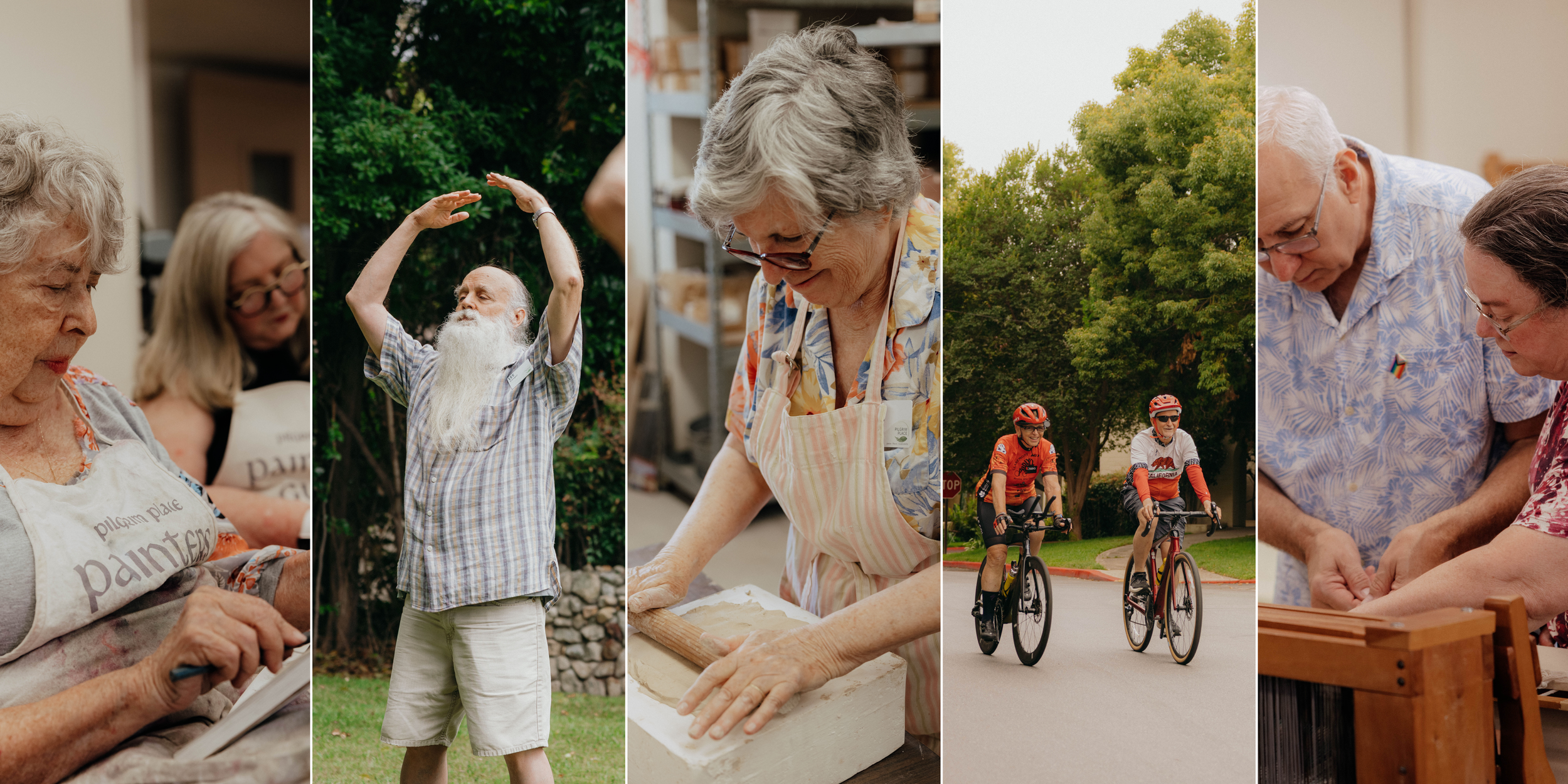
Pilgrim Place in Claremont, California offers one of the clearest examples of what purposeful retirement looks like when built from genuine mission. Residents at Pilgrim Place don’t retire from their life’s work in peace, justice, and environmental stewardship. They continue it. The campus reflects its values: ecologically maintained, walkable, and connected to the intellectual and cultural life of the adjacent Claremont Colleges.
It supports sustainability initiatives, resident-led programs, and advocacy work. For residents who spent decades of their professional life in social justice, peacebuilding, and environmental activism, Pilgrim Place honors that identity and keeps it active.
The nearby Claremont Colleges provide opportunities for residents to engage with faculty and students, attend lectures, and participate in broader community conversations.
Pilgrim Place offers a full continuum of care — independent living, assisted living, memory care, and skilled nursing — within a culture that remains consistent across every level. Transitions feel like steps in the same story, not moves to a different facility.
How Community Culture Shapes Daily Experience
The difference between a community that talks about purpose and one that structures it into daily life shows up in small things. Do residents greet each other by name? Do they talk about what they’re working on, or just what they did yesterday? Is there a resident council with real authority, or a suggestion box that gets reviewed quarterly? Communities where residents participate actively in governance consistently show stronger social cohesion and higher satisfaction scores than those where residents are primarily beneficiaries of care.
Culture isn’t listed in a brochure. It shows up in how residents talk about their days. The most reliable way to assess it is to visit at multiple times, including mealtimes and unscheduled hours, and to speak with current residents directly. Ask them what they did this week that mattered. Their answers will tell you more than any tour.
Understanding the Costs of Mission-Led Senior Living
How Life Plan Communities Compare to Rental Models
Two primary financial structures exist in senior living, and understanding the difference is essential before evaluating any community. Rental communities charge a monthly fee, typically between $3,100 and $5,350 depending on care level, according to national median data, with no significant upfront commitment. The lower barrier to entry is real, but so is the exposure: as care needs grow, additional services are billed separately at market rates, and monthly fees can escalate significantly over time. For seniors who expect to need assisted living or skilled nursing at some point, the math on rental models can become difficult quickly.
Life Plan communities, also called CCRCs, require an entry fee, typically between $100,000 and $450,000, often with a portion refundable to the estate, based on national median ranges. In exchange, residents receive access to the full continuum of care, including assisted living, memory care, and skilled nursing, with predictable monthly costs that don’t spike when health needs increase. Over a ten-year period that includes a significant care transition, the Life Plan structure can compare favorably to rental on total cost, though outcomes vary based on individual care trajectories and regional pricing. For families planning beyond the next two years, this structure deserves serious financial analysis.
Why Nonprofit CCRCs Often Deliver Better Long-Term Value
Many purpose-driven communities operate as nonprofits, and that organizational structure affects both their finances and their mission fidelity. Nonprofit CCRCs reinvest operating surplus into the community rather than distributing it to shareholders. This tends to support better staffing stability, richer programming, longer-term capital planning, and a culture where decisions are guided by mission alignment rather than margin targets. For residents who plan to stay connected to their values for decades, that difference is meaningful.
Entry fees at many nonprofit Life Plan communities are partially or fully refundable, and they include priority access to higher levels of care without requiring a move to an unfamiliar facility. Residents who enter as independent living members and later need memory care or skilled nursing remain in the same community, surrounded by the same people and culture. That continuity carries both emotional and clinical value. Communities like Pilgrim Place, structured around nonprofit mission and a full care continuum, offer this kind of long-term stability alongside the purposeful living that draws residents there in the first place.
Questions Worth Asking Before Choosing a Purpose-Driven Community
Culture and Values Alignment Questions
The right questions to ask during a community tour are the ones that reveal whether purpose is lived or laminated onto a mission statement. Instead of focusing on amenities or surface-level programming, ask questions that uncover how people live, connect, and contribute to one another.
Questions worth asking include:
How are residents involved in implementing change?
If someone has an idea for a new program or initiative, what typically happens next?
What are residents here working on right now that feels meaningful to them?
What does a typical evening look like when nothing is scheduled?
What happens when someone is going through a difficult time, like illness, loss, or transition?
Who could I speak with to get the most honest perspective about living here?
What kind of person tends to thrive here, and who might not find it to be the right fit?
What do residents feel responsible for, not just included in?
How does the community support someone as their needs change over time?
The answers reveal whether a community has built purpose into its structure or simply added a volunteer option to its wellness calendar. Pay attention to how staff talk about residents. Do they use names? Do they know people’s histories? High familiarity between staff and residents is a reliable proxy for the kind of relational culture that supports both safety and belonging.
Staff, Resident Relationships, and What Turnover Reveals
Staff turnover is one of the most reliable signals that a community’s culture matches its brochure. When staff stay long-term, they build genuine relationships with residents. They know who prefers morning quiet, who needs encouragement to join group meals, and who is having a hard week. That knowledge doesn’t come from a care plan. It comes from years of daily contact. Ask about average staff tenure directly, and notice whether the person answering seems proud of the answer or hesitant.
Communities that handle difficult transitions — memory decline, end-of-life care, or the loss of a long-term partner — with transparency and structured support demonstrate values in practice. Ask specifically how the community supports residents through grief and cognitive change. The quality of that answer tells you more about daily culture than any amenity list.
Practical Steps Before You Visit
A few concrete preparations will make any community visit significantly more useful. Research the community’s nonprofit status and mission history before you arrive. Review CMS quality ratings for the skilled nursing component if a full continuum of care matters to your planning. Write a short list of what “purpose” means specifically to the person who will live there, and use that list to evaluate what you observe, not just what you’re told. Schedule your tour to include a community meal or a resident-led activity — what residents are doing when no one is directing them tells you everything.
The Right Choice Isn’t the Longest Amenity List
The seniors choosing purpose-driven retirement communities aren’t settling for less. They’re choosing more: more meaning, more contribution, more genuine connection. The research backs this up with hard data on hospitalizations, Medicare costs, mortality risk, and loneliness reduction. The communities themselves back it up with resident-led governance, lifelong learning, and programs that extend a lifetime of values rather than shelving them.
For anyone evaluating options right now, the clearest filter is this: are the people living there still doing work that matters to them? Meaningful-engagement retirement living, at its best, doesn’t ask residents to step back from their purpose. It gives that purpose a new home. Communities like Pilgrim Place, rooted in service, justice, and intentional living on a walkable campus in Claremont, California, show what this looks like when it’s done well.
Use the questions in this article to evaluate any community on your list. Then trust what you observe when no one is performing for the tour. If you’d like to see Pilgrim Place for yourself, we invite you to schedule a visit and spend time with the people who live here. Their answers will tell you what you need to know.
Frequently Asked Questions
-
A purpose-driven retirement community is a residential environment where daily life is organized around shared values—such as social justice, service, or environmentalism—rather than just leisure. Unlike traditional "resort-style" senior living, these communities empower residents to lead initiatives, participate in governance, and continue their life’s work in advocacy or education.
-
Research shows that seniors with a strong sense of purpose experience a 57% lower mortality rate and significantly lower risks of cognitive decline. Clinical studies indicate that meaningful engagement acts as a "non-pharmacologic intervention," leading to fewer hospitalizations, reduced emergency room visits, and approximately $7,200 in annual Medicare savings per resident after three years of residency.
-
A CCRC (Continuing Care Retirement Community) provides solo agers with a built-in support network and guaranteed access to higher levels of care on a single campus. This "continuum of care" eliminates the stress of future health transitions, ensuring that seniors without nearby adult children have professional and community-based advocacy throughout their aging journey.
-
The luxury resort model often fails to address the "epidemic of loneliness" because it treats residents as passive consumers rather than active participants. While comfort is important, research from the U.S. Surgeon General highlights that social connection and feeling "needed" are more critical for long-term well-being than high-end amenities alone.
-
The best way to evaluate culture is to ask about resident governance and staff longevity. Look for communities where residents hold real authority over decisions and where staff tenure is long-term. High familiarity between staff and residents is a reliable indicator of a relational culture that supports genuine belonging and safety.
